
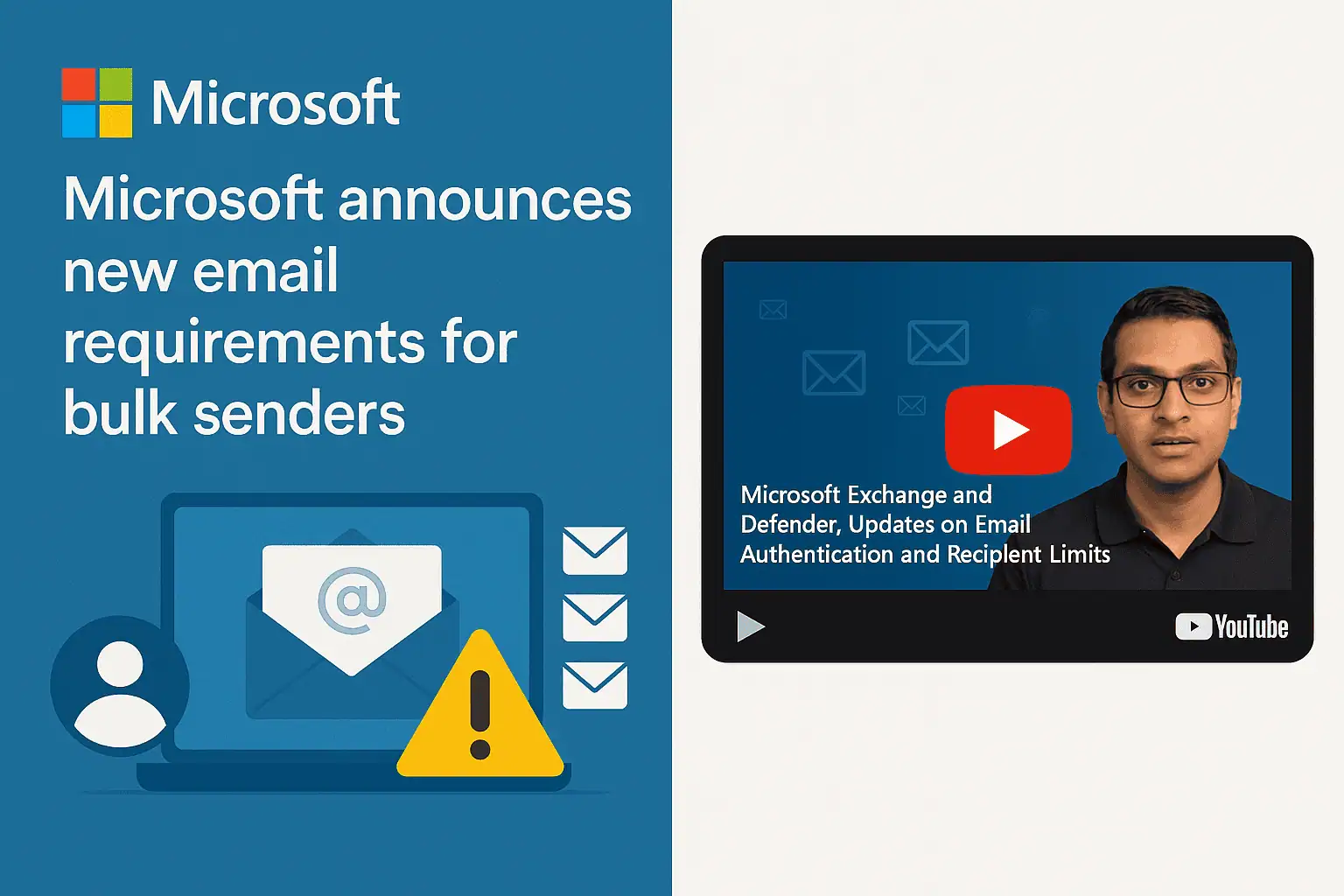
Update (January 2026): Microsoft has cancelled the 2,000 external recipient limit described in its original announcement. This article has been updated to reflect the current email rules for bulk senders on Microsoft platforms.
In April 2024, Microsoft announced new email rules for bulk senders using Exchange Online. The plan was to cap each mailbox at 2,000 external recipients in any rolling 24-hour period, to reduce spam and stop Exchange Online being used for mass mailing. After strong customer feedback, Microsoft cancelled the limit indefinitely on January 6, 2026. Here is what changed, what still applies, and what bulk senders should do now.
What Microsoft originally announced
The new External Recipient Rate (ERR) limit was designed as a sub-limit inside the existing Exchange Online Recipient Rate limit of 10,000 recipients per mailbox per day. No more than 2,000 of those recipients could be outside your organization. The rollout was planned in two phases:
- Phase 1: From January 2025, for cloud-hosted mailboxes in newly created tenants.
- Phase 2: Between July and December 2025, for cloud-hosted mailboxes in existing tenants. This date was later pushed back to 2026.
Why Microsoft cancelled the limit
Businesses reported that the cap would disrupt everyday work, such as sales outreach, customer notifications and emails sent by business applications. The counting method also caused concern, because every recipient on every message counted toward the limit, even repeat sends to the same people. Microsoft said it will pursue less disruptive, more adaptive ways to fight abuse instead. Read the Exchange Team announcement for details.
Email rules for bulk senders that still apply
- Recipient Rate limit: Exchange Online still limits each mailbox to 10,000 recipients per day.
- Tenant-level external recipient limit: A separate cap on external recipients for the whole organization remains in place.
- Outlook.com high-volume sender requirements: Since May 2025, domains sending more than 5,000 emails a day to Outlook.com, Hotmail.com and Live.com addresses must pass SPF, DKIM and DMARC checks, or their messages can be rejected.
- Exchange Online is not a bulk mail service: Microsoft still recommends dedicated services, such as Azure Communication Services for Email, for high-volume external mail.
What bulk senders should do now
- Review your sending patterns: Check which mailboxes and applications send large volumes of external email.
- Set up email authentication: Publish SPF, DKIM and DMARC records for every domain you send from. This protects deliverability and makes your domain harder to spoof.
- Move mass mailing to the right platform: Use a dedicated bulk email service for newsletters, marketing campaigns and application notifications.
- Train your team: Make sure staff know the limits and how to recognize spoofed messages. Our guide on how to spot a phishing email is a good place to start.
- Monitor deliverability: Track bounces, spam complaints and DMARC reports so you catch problems early.
Conclusion
The planned 2,000 external recipient limit is gone for now, but Microsoft’s email rules for bulk senders have not disappeared. The daily recipient limits still apply, authentication is now required for high-volume senders to Outlook.com, and Microsoft plans new ways to fight abuse. Organizations that authenticate their mail and use the right tools for bulk sending will be ready for whatever comes next.
For more email tips and updates, browse our Email articles.